
Featured Engineering Substrates (Series I)
Explore our precision functional nonwoven fabrics manufactured with tightly controlled hydroentanglement and extrusion lines. Each roll meets stringent tensile, barrier, and functional criteria.
-
Bio-Active

High-Quality Mosquito Repellent Nonwoven Fabric Products
View Specifications -
Smart Tech

China Graphene Conductive Spunlace Nonwoven Fabric
View Specifications -
Extreme Temp

High-Quality Basalt High-Temperature Nonwoven Fabrics
View Specifications -
Carded Web

China Parallel Spunlace Nonwoven Technical Fabrics
View Specifications -
Medical Hygiene

China Antibacterial and Deodorizing Functional Spunlace
View Specifications -
Composite

Extrusion Laminated Spunlace Nonwoven Barrier Fabric
View Specifications -
Performance

Functional Finishing Spunlace Nonwoven Fabric Series
View Specifications -
Coating Base

High-Quality Powder Dusted Interlining Spunlace Nonwoven
View Specifications
Spunbond & Hydroentanglement Industry Architecture
Strategic convergence of continuous filament extrusion, thermal bonding, and water-jet hydroentanglement across Chinese modern manufacturing facilities.
Filament vs. Staple Polymer Engineering
Traditional spunbond processes leverage continuous filament extrusion via multi-beam spunmelt extruders (PP, PET, PLA), yielding exceptional MD/CD tensile ratios and structural stability for roofing, geotextiles, and medical SMS wraps. In contrast, hydroentanglement (spunlace) incorporates staple fiber matrices (viscose, lyocell, polyester, cotton) interlocked without binders under hydraulic water jets up to 250 bar.
Hybrid Composite Technologies (SMS / SPC)
The boundary between spunbond and carded technologies has blurred with modern composite laminates. By laminating continuous spunbond polypropylene (PP) outer carriers to meltblown (M) bacterial barrier layers, or hydroentangling spunlace nonwovens with wood pulp and polymer films, Chinese manufacturers deliver hybrid barriers that achieve high hydrostatic head resistance while preserving soft tactile feel.
Circular Carbon & Eco-Compliance
Global decarbonization mandates (EU Single-Use Plastics Directive 2019/904, REACH Annex XVII) demand clean raw materials. Leading China mills are accelerating transition from fossil polypropylene to certified biodegradable polyhydroxyalkanoates (PHA), polybutylene succinate (PBS), polylactic acid (PLA), and recycled rPET verified via Global Recycled Standard (GRS) chain-of-custody protocols.
Macro Solutions Across Core Sectors
Overcoming tariff volatility, roll width conversion inefficiencies, and specialized functional finishing hurdles through single-mill vertical integration.
| Target Sector | Predominant Fiber / Web Matrix | Physical & Chemical Benchmarks | Engineered Manufacturing Solution | Compliance Standards |
|---|---|---|---|---|
| Medical & Surgical Barrier | PP Spunbond + Meltblown (SMS/SMMS), Viscose/PET Spunlace | Hydrostatic head > 50 cm H2O, AATCC 42 < 1.0g impact penetration, lint index < 10 | Inline fluorochemical / repellent finishing, cleanroom high-pressure hydroentanglement | AAMI PB70 Level 3/4, EN 13795, ISO 10993 Cytotoxicity |
| Synthetic Leather Substrates | 100% PET Microfiber, High-shrinkage Polyester Blends | Isotropic MD/CD ratio (0.9–1.1:1), tensile strength > 450 N/5cm, surface smoothness | Cross-lapping carding, chemical sizing, pad-dyeing with deep shade saturation | REACH SVHC, RoHS 3.0, OEKO-TEX Eco-Passport |
| Technical Thermal & Filtration | Polyimide (P84), Basalt filament, Carbon fiber, Pre-oxidized PAN | Continuous thermal stability up to 260°C–600°C, LOI > 38%, acid/alkali tolerance | High-pressure needle punching and water-jet compaction without synthetic chemical binders | UL94 V-0, DIN 4102 B1, ISO 16890 HEPA pre-filtration |
| Beauty, Cosmetics & Hygiene | 100% Viscose, Bamboo, PLA, Organic Cotton | Absorption capacity > 900%, skin contact hypoallergenic, ultra-soft zero-lint drape | Apertured hydroentanglement tooling, custom embossing, continuous peroxide bio-bleaching | ISO 22716 GMP, FDA 21 CFR 177, Biodegradability EN 13432 |
| Industrial Smart Wipes & EMI | Graphene-doped Viscose, Conductive Carbon Yarn Blends | Surface resistivity 10^3–10^8 Ω/sq, static decay time < 0.1s, high wet abrasion resistance | Inline conductive polymer bath immersion, ultrasonic web perforated micro-drilling | ANSI/ESD S20.20, ATEX Directive 2014/34/EU |
Precision Production Line Architecture
From raw polymer and fiber bale selection to automated finished-roll slitting, every process is unified under one roof at our Changshu facility.
Polymer & Fiber Intake QC
Raw polyester, viscose, polypropylene, PLA, and specialty fibers (carbon, basalt, polyimide) undergo moisture testing, dtex denier verification, and batch-purity checks prior to pneumatic opening.
Carding & Web Geometry
Automated high-speed carding machines orient fibers into parallel or cross-lapped webs. Advanced cross-lappers govern basis weight uniformity, balancing the machine-direction to cross-direction tensile ratio.
Hydroentanglement / Spunbond
High-pressure deionized micro-water jets mechanically interlock staple webs into dense, chemical-free nonwovens. Parallel spunmelt lines utilize thermal calender embossing rolls for continuous filament bonding.
Tension-Free Controlled Drying
Perforated through-air drying drums evaporate moisture without compacting the web's loft, preserving soft bulkiness, three-dimensional aperture definition, and fiber hand feel.
In-House Dyeing, Sizing & Finish
Unlike factories that subcontract finishing, our mill operates integrated pad-dyeing, chemical sizing, precision gravure pattern printing, water-repellent coating, and flame-retardant baths on-site.
Optical Scan & Slit Packaging
Continuous CCD camera scanning detects foreign particles, slubs, or hole variations in real time. Laser-guided slitting heads slice custom widths for ocean-freight container packing.
Engineering Milestones (2025–2030)
Pioneering the next generation of nonwoven materials through continuous investment in smart monitoring, nanotechnology, and zero-carbon fibers.
AI Closed-Loop GSM Regulation
By deploying beta-gauge radioactive/laser web density sensors synchronized with high-precision feeder servos, our spinning lines achieve real-time basis weight deviation under ±1.2%, cutting material scrap and ensuring consistent tensile strength throughout million-meter master roll production runs.
Real-Time Sensor Closed-Loop Variance < ±1.2%Micro-Encapsulated Active Fabrics
Integrating sub-micron polymer shell chemistry during hydroentanglement allows controlled sustained release of active formulations. From citronella mosquito repellent substrates to cooling phase-change materials (PCM) and thermochromic heat-sensitive indicator fabrics, functional versatility is engineered directly into fiber intersections.
Micro-Encapsulation Sustained Release FinishPFAS-Free Hydrophobic Barriers
Anticipating universal global prohibitions on per- and polyfluoroalkyl substances (PFAS/PTFE), our R&D team has formulated organosilicon-modified bio-wax water repellent emulsions. This delivers AATCC 22 water spray ratings of 100 and high alcohol repellency without fluorinated persistence.
100% PFAS-Free AATCC Spray 100International Trade Expos & Field Engagements
Meet our senior material engineers and review certified production samples at the world’s foremost technical textile congresses.
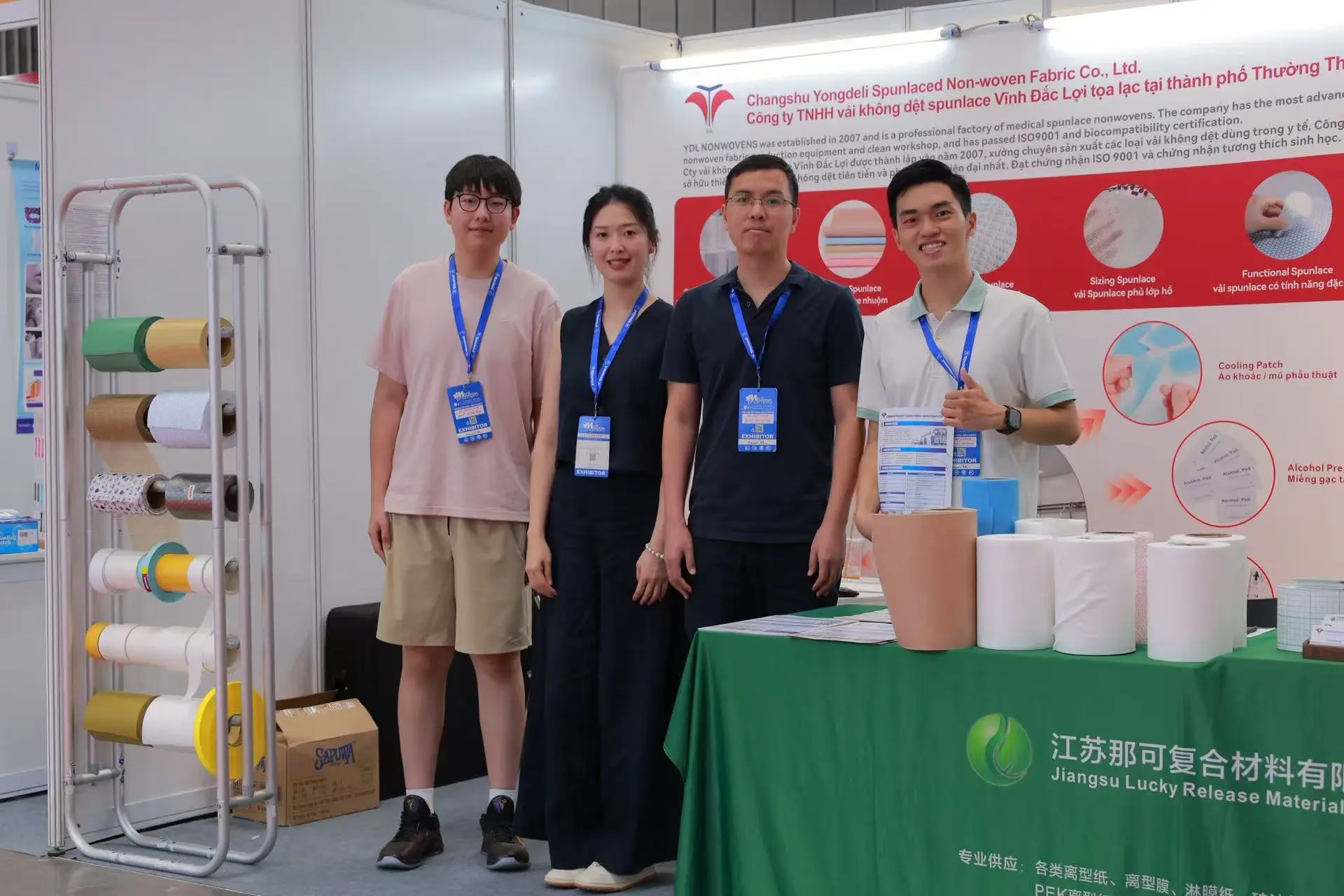
Vietnam Medipharm Expo 2025
Showcasing surgical medical nonwovens, wound dressings, and antimicrobial spunlace grades at the Saigon Exhibition & Convention Center (SECC), Ho Chi Minh City.
Review Exhibition Catalog
ANEX 2024 Asia Nonwovens Expo
Demonstrating functionalized spunlace, anti-static nonwovens, and high-efficiency filtration media at the Taipei Nangang Exhibition Center.
Review Exhibition Catalog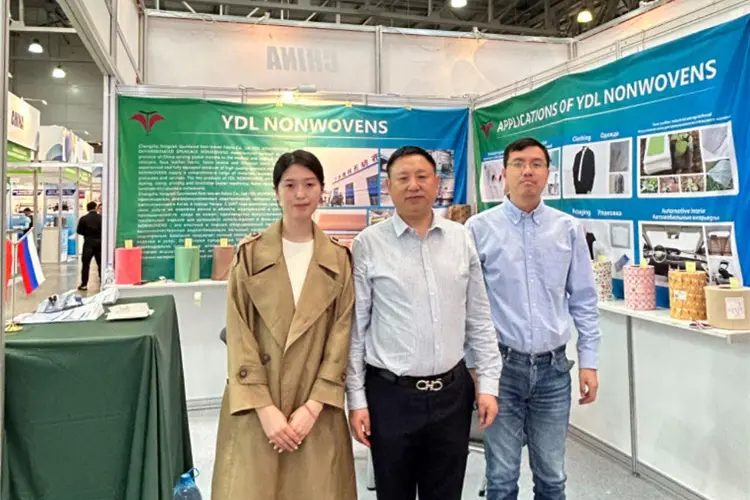
Technotextil Technical Textiles
Convening with industrial fabric converters and automotive leather base manufacturers at Crocus Expo Moscow, establishing stable multi-year logistics frameworks.
Review Exhibition CatalogFrequently Answered Sourcing Inquiries
Direct answers formulated by our chemical engineers and export documentation officers to accelerate vendor audits.
How do spunbond and spunlace technologies differ in tensile and tactile feel?
What raw fiber blends are fully supported at your Changshu facility?
Can functional finishes (water repellent, flame retardant, anti-static) be applied in-house?
What are typical minimum order quantities (MOQ) and production lead times?
How does YDL maintain lot-to-lot color fastness and physical consistency?
How can overseas converters request Technical Data Sheets (TDS) and A4 sample books?
Featured Engineering Substrates (Series II)
Advanced specialty, conductive, elastic, and high-performance interlining nonwovens engineered for global conversion operations.
-
ESD Control

High-Quality Anti-Static Spunlace Nonwoven Fabric
View Specifications -
Specialty Tech

China Functional Magnetic Spunlace Nonwoven Fabric
View Specifications -
Composite Reinforcement

Carbon Fiber Technical Nonwoven Fabric Catalogue
View Specifications -
Laundry Care

Black Clothing Darkening & Color Preservation Sheets
View Specifications -
High Elasticity

China Multi-Directional Elastic Spunlace Fabric
View Specifications -
Micro-Porous

High-Quality Ultrasonic Drilling Nonwoven Fabric
View Specifications -
Clean Absorbent

Pure White Medical Viscose Spunlace Nonwoven Fabric
View Specifications -
Medical Elastic

China Spandex Elastic Spunlace Nonwoven Fabric
View Specifications
Partner with an ISO 9001 Certified Chinese Nonwoven Mill
Changshu Yongdeli Spunlaced Non-woven Fabric Co., Ltd. (YDL Nonwovens) has engineered conventional and functional nonwoven fabrics since 2007. Connect directly with our material engineers to configure exact basis weight, web orientation, slit dimensions, and performance chemistries.